Memory with governance, not just memory
Most approaches give an AI some memory. Few give a company governed flow: who may write, who may read, and who decides what becomes shared knowledge.
Where The AI Hive sits among the alternatives
We compare categories of product, not named products. Each category has strong options for the job it was built for.
| Capability | Developer memory kits (e.g. Mem0, Zep, Letta) | Vendor-built assistant memory | Enterprise search | Governed context layers | The AI Hive |
|---|---|---|---|---|---|
| Works with any AI app via open standards | Partly | No | Partly | Partly | Yes (most vendors in testing) |
| Learns new facts from AI work | Yes | Yes | No | Yes | Yes |
| Scopes person, team, project and company, with approval | Partly | Partly | No | Yes | Yes |
| Client walls | Partly | No | Partly | Yes | Yes |
| Runs on your own servers | Partly | No | Partly | Partly | Yes |
| Audit of every read, write and approval | No | Partly | Partly | Yes | Yes |
| One governed feed from company sources, so personal connectors can stay off | No | No | Yes | Partly | Partly (Jira, mailboxes, databases today) |
| Mature at large scale | Partly | Yes | Yes | Partly | Not yet (pilot) |
Categories vary by product and change quickly; this is our general view as of October 2026. Check the specifics of any product you are evaluating.
One governed memory instead of many connectors
Every connector a person switches on in their AI app adds tools, instructions and raw data to the model's context, outside any company rules. The AI Hive reads company sources on your server and gives the AI one budgeted, governed context.
+3,139 tokens
added to every request by six idle mail, drive, calendar and document connectors in a measured Claude Code test, before any of them was used.
~23,400 tokens
when one mail connector's 30 tools are loaded, and up to 25,000 more for a single result. An AI Hive context pack stays within the token budget you set per app (500 to 100,000).
About −66%
tokens processed in a simulated developer day when connectors are switched on only for the tasks that need them, instead of being always on.
Each person's own connectors
- Raw mail and files reach the AI with no scopes, client walls, approvals or audit
- Approved knowledge and unapproved raw data can disagree, and the AI cannot tell which is which
- Tool definitions and large results crowd the context window
- Overlapping tools make the AI's tool choice worse
- Private data, untrusted inbound content and a send tool end up in one agent
Company sources through The AI Hive
- Read on your server; facts extracted by a small model on your own infrastructure
- Shared knowledge only after a lead approves it, with client walls and an audit trail
- The AI gets one context pack, within a token budget, labelled as data
- A small, stable set of memory tools instead of dozens of connector tools
- Read-only by design: The AI Hive never writes into outside systems
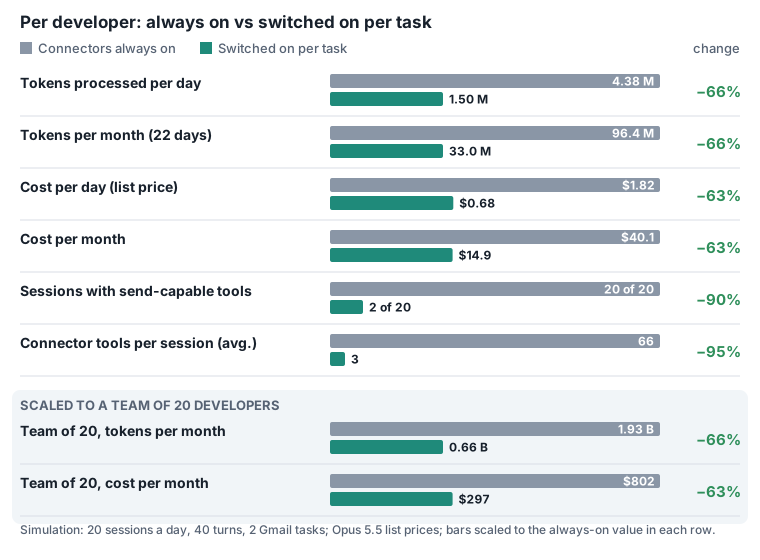
Figures from a test on Claude Code 2.1.296 (13 October 2026) and a simulation with stated assumptions; method and sources in our research note What connectors cost. Connected sources today: Jira Cloud (read-only), mailboxes over IMAP and PostgreSQL views, plus mapping of git repositories to projects; Microsoft 365 and Gmail sign-in are on the roadmap.
What we are, and what we are not yet
Where The AI Hive is strong
- One memory shared by people and many different AI apps, over MCP and REST; change vendor or use several at once (multi-vendor access is in testing)
- Promotion, inheritance and synthesis with explicit approvals
- Client walls and audience labels for keeping material apart
- An audit trail of what the AI knew
- Runs in your cloud or on your premises
Where we are honest about limits
- The AI Hive runs on our pilot deployment. It is not yet mature at large scale, and large-scale load testing is on the roadmap.
- We cover a deliberately narrow set of read-only connectors today.
- It is not a fit for very small teams or one-off work.
Your people are not forced onto one brand of laptop or email client. Why should your AI memory be locked to one model?
See how The AI Hive could work in your organisation
We are onboarding a small number of design partners to the pilot programme. Tell us about your teams and the AI tools they use, and we will scope a pilot together.